
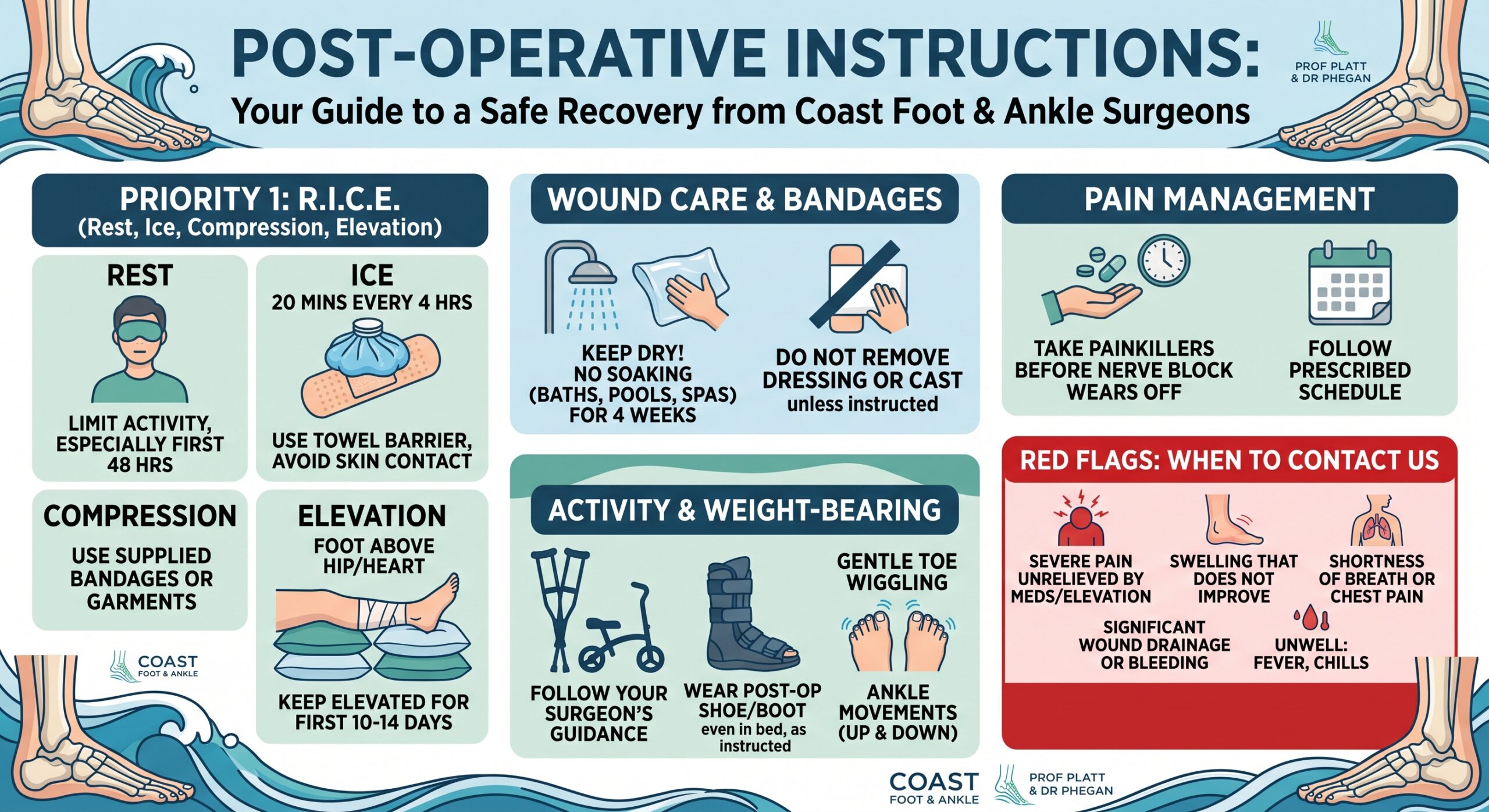
Post-Operative Care and Recovery
Following your post-operative instructions can help manage pain and swelling while supporting recovery after foot or ankle surgery. Resting and elevating the affected foot are particularly important during the early recovery period. Our surgeons work closely with rehabilitation physiotherapists to provide personalised guidance on wound care, medication, movement and your gradual return to everyday activities.
- Rest, ice, compression and elevation guidance
- Advice for managing post-operative swelling
- Prescribed pain medication instructions
- Surgical wound and dressing care
- Safe use of post-operative shoes or boots
- Gentle movement and rehabilitation exercises
- Blood clot risk assessment and prevention
- Personalised physiotherapy and recovery planning
RICE (Rest, Ice, Compression, Elevation)
REST
In the first 24-48 hours after surgery you are likely to experience swelling and pressure in the foot. This is normal; the more you keep the foot elevated, the quicker this will settle.
ICE
Use ice packs or a bag of frozen peas on the affected limb. Do this for 20 minutes every 4 hours. Remember to place a towel between the cold pack and your skin to avoid injury and never have the ice pack in direct contact with your skin.
COMPRESSION
Use compression bandages or garments if these have been supplied by your treating therapist.
ELEVATION
- Keep your foot elevated as much as possible for the first 10-14 days after surgery
- Sit or lie with your foot elevated above your hip. Try resting it on 2-3 pillows
- In bed, put 4-5 pillows under your foot if you are able
Pain medication after surgery
We recommend that you take your prescribed pain management medication regularly during the post-operative period. Don’t wait until you feel pain.
- If we’ve used a local anaesthetic nerve blockade during your foot and ankle surgery, your foot will feel numb for up to 24 hours (more usually 12-16 hours). You should feel no pain during this time.
- Our surgeons advise that you take your painkillers BEFORE the effect of the nerve blockade wears off.
- Take painkillers a couple of hours before bedtime, before your outpatient appointment and any therapist appointments.
- Take your painkilling medication at the prescribed intervals.
- If you require additional pain relief please contact your GP for this.
Surgical wound care
- Wear your post-operative shoe or boot even when walking around the house.
- Wear it in bed until your first post-operative visit.
- Keep your cast or bandages dry.
- When you have a shower or a bath, wrap your dressings in a plastic bag that you can seal around the leg.
- Do not smoke as this will weaken the wound healing process.
Exercise after surgery
Do some gentle exercise. Our foot and ankle surgeons, Prof Platt and Dr Phegan, will tell you what exercise is right for you. Depending on your surgery, this will probably involve gentle movements to your ankle (up and down and rotation), and regular flexing and extending (wriggling) of toes.
You will find out what exercises you need to do before you leave the hospital, and again at your first therapy visit.
Risk of blood clots and DVT (deep vein thrombosis)
Most people who have had foot surgery do not need medication to prevent blood clots in their legs (DVT).
- If you are allowed to put weight on your foot, keeping your foot moving and having enough to drink is all you will need to do.
- If our surgeons have advised you not to put weight on your foot, our sugeons will prescribe Clexane (enoxaparin) injections for DVT prevention.
- If you cannot take Clexane, e.g. you have a history of bleeding disorders or kidney/liver issues, our surgeons will advise you accordingly.
- If you have a previous history of DVT or other factors that increase your risk of DVT, our surgeons will discuss and prescribe appropriate medication.
Recovery after foot and ankle surgery
Recovering from foot and ankle surgery can take up to 18 months, depending on the type of surgery that you have had. Your foot may be swollen for a few months. Most swelling settles down within 6 months.
Most people return to comfortable, day to day activities within 3 months and usual activity and function generally returns within 6 months to a year.
If getting back into sport is your goal, your physiotherapist will start your return to sport regime about 3 months after your surgery. Again, this will vary from individual to individual, and depend on the type of surgery that you have had.
These guidelines for recovery are broad and will vary between individuals. Prof Platt and Dr Phegan work closely with a range of therapists to optimise and accelerate your recovery. Therefore, your treatment and recovery journey will be customised to you.
Our surgeons will liaise directly with your physiotherapy team with specific post operative instructions. Your initial physiotherapy visit will address wound care, oedema management, cast/ brace fitting or modifications, and the prescription of your individualised rehabilitation exercises.