
Chronic Ankle Instability Treatment
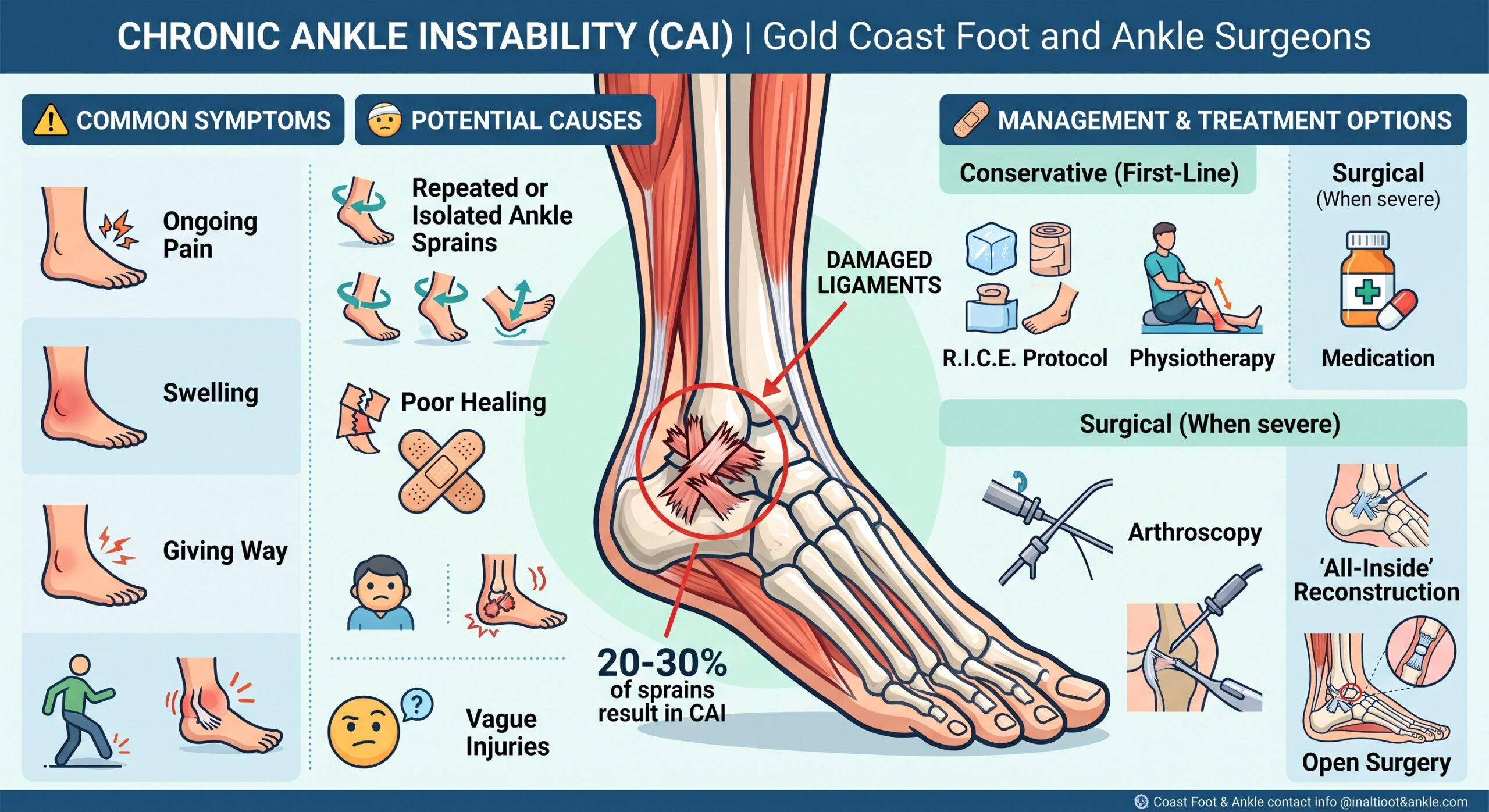
Chronic ankle instability can cause persistent pain, swelling and the sensation that the ankle may give way during everyday activities. It often develops when ligaments damaged by an ankle sprain or repeated injuries fail to heal correctly. Our foot and ankle surgeons assess the ankle and may use X-rays and MRI scans to confirm the extent of the injury before recommending a personalised treatment plan.
- Assessment of persistent ankle pain and swelling
- Diagnosis supported by X-rays and MRI scans
- Treatment for ankles that repeatedly give way
- Rest, ice, compression and elevation guidance
- hysiotherapy and supervised rehabilitation
- Medication options for pain and inflammation
- Arthroscopic ankle ligament reconstruction
- Post-operative recovery and return-to-sport guidance
Do I have chronic ankle instability?
Chronic ankle instability is a common problem. In fact, if you are reading this it may be because your ankle is giving you ongoing trouble. It may also be that you feel as if your ankle has never been managed properly and there is ongoing pain.
What are the symptoms of chronic ankle instability?
A common symptom of chronic ankle instability is the sensation that your ankle may give way during day to day activities. Usually it is a feeling that the ankle has never properly healed from a previous injury. Many people with this condition experience:
- Pain
- Swelling
- Feeling like your ankle is giving way
What causes chronic ankle instability?
Chronic ankle instability is usually caused by an ankle sprain or injury. Ankle sprains are a very common and frequently occurring sporting injury. Most ankle sprains settle down and never cause any further problems. About 20-30% of ankle sprain injuries go on to cause problems. Usually this is a result of damaged ligaments that have not healed properly. Common causes of chronic ankle instability include:
- Repeated ankle sprains
- Isolated ankle sprain
- Vague significant injury to the ankle
How is chronic ankle instability diagnosed?
Our foot and ankle surgeons, Prof Platt and Dr Phegan, can usually make the diagnosis of chronic ankle instability by taking a detailed history and examining your ankle in the clinic. X-rays and an MRI scan are usually needed to confirm the extent of the problem.
What is the treatment for chronic ankle instability?
In early cases with mild symptoms the standard R.I.C.E regime is used. This means:
- Rest
- Ice
- Elevation
- Compression
This is recommended as the first line of treatment, and is suggested alongside early involvement by a physiotherapist to rehabilitate the ankle through a supervised exercise regime. Non-steroidal anti-inflammatory medications can help to settle the pain and swelling.
Surgery for chronic ankle stability is suggested when symptoms fail to resolve.
The symptoms are usually pain and the ankle repeatedly giving way. Surgery is performed under general anaesthetic and it is usually done as a day procedure.
Surgery involves placing a small camera (arthroscope) into the ankle joint and fully assessing any problems. From here, the ligaments may be reconstructed. Arthroscopic surgery is minimally invasive. In very severe cases and those with failed previous surgeries, our surgeons will reconstruct the ligament using an open technique with an artificial ligament. Your surgery will be fully discussed with you.
All-inside' ligament reconstruction
Dr Simon Platt is one of only a handful of orthopaedic surgeons in Queensland performing an all-inside ligament reconstruction to help patients suffering from chronic ankle instability get back into the sporting arena.
Recovery after chronic ankle instability surgery
Symptoms usually resolve rapidly after surgery. Your ankle will almost certainly feel stiffer after surgery, and it is common for some pain and stiffness to be present for a few months. Remember that that the reason surgery was recommended was that the ankle was very unstable.
The most important instructions are to rest and elevate your foot after your surgery. This will reduce bleeding and swelling and ultimately reduce pain. During recovery it is very important to follow these instructions, take regular painkillers and attend physiotherapy.
Your recovery time depends on your individual surgery and situation. You will need to wear a boot for the first 6 weeks as your ankle becomes stronger. During the first four weeks you must sleep in your boot. Your physiotherapist will help you get your ankle back to its proper function.
Returning to sport will take around 6 to 9 months, depending on the activity and level of participation. Some patients may have stiffness or aching for some time after the surgery and occasionally, additional treatment or surgery may be required there are ongoing problems.